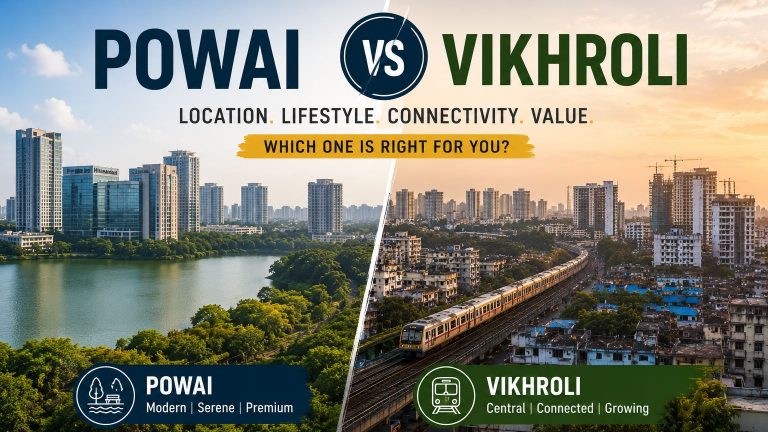
At some point in every tech professional’s Mumbai housing search, the same two names come up. Powai, because everyone’s heard of it and it sounds right. Vikhroli, because someone at the office mentioned it and the rent is lower and you’re not sure if that’s good or suspicious.
This is that conversation, done properly.
What You’re Actually Choosing Between
Powai and Vikhroli are not interchangeable suburbs that happen to be near each other. They represent two genuinely different bets — one on an established ecosystem that’s already priced in, the other on infrastructure that’s still arriving.
Powai is finished. It has IIT, Hiranandani, the lake, the cafés, the walkable high street, the corporate parks. Everything that makes it desirable exists and is legible. The price reflects this.
Vikhroli is mid-sentence. The Godrej township on one side, the LBS Marg corridor on the other, and Metro Line 6 — the one that will connect Vikhroli to Lokhandwala in the west — expected to be operational by late 2026 or early 2027. Vikhroli is selling you a neighbourhood that’s still being built, at a price that hasn’t fully caught up to what it’s becoming.
Neither is a bad choice. They’re just different risk profiles.
The Rent Numbers
Powai: A 1BHK in Powai runs Rs.32,000 to Rs.55,000 depending on the building and pocket — Hiranandani itself at the top end, Chandivali and the MHADA colony areas at the lower end. A 2BHK in a decent building runs Rs.55,000 to Rs.90,000. The Hiranandani township commands a premium because it delivers: quality construction, maintained common areas, actual amenities. You are paying for a finished product.
Vikhroli: A 1BHK in Vikhroli runs Rs.18,000 to Rs.30,000. A 2BHK runs Rs.28,000 to Rs.48,000. Vikhroli West, closer to the station and the newer Godrej projects, is at the higher end of that range. Vikhroli East, with more mixed building stock, is lower.
The gap is real and it’s meaningful. For the same Rs.35,000 budget, Powai gives you a 1BHK on the edge of the catchment area. Vikhroli gives you a comfortable 2BHK in a decent building, possibly with parking.
The Commute Question — Which Matters More Than Everything Else
Both suburbs are on the JVLR corridor, which is the artery that connects the eastern and western suburbs without going through the city. Both have Vikhroli railway station within reach. Both are close to the Eastern Express Highway.
But the commutes are not identical and the differences are worth mapping against your specific office location.
If your office is in Powai or Hiranandani Business Park: Living in Powai means you potentially walk or take a 5-minute rickshaw. Living in Vikhroli means 15-20 minutes on the JVLR or a local train to Vikhroli station, then forward. For most working days that’s fine. During heavy rain, JVLR is one of the roads that gets difficult.
If your office is in Andheri East or SEEPZ: Powai has a slight edge via the JVLR straight shot. Vikhroli gets there similarly but with marginally more traffic variability. Train from Vikhroli to Andheri works and is fast.
If your office is in BKC: This is where Vikhroli’s Metro Line 6 story becomes significant. Once operational, the metro will connect Vikhroli directly westward to the central and western hubs. Until then, BKC from Vikhroli involves a combination of road and train that adds time. Powai via the JVLR to BKC is the current faster option.
If your office is in Lower Parel, Worli, or South Mumbai: Eastern Freeway from Vikhroli area runs down to South Mumbai in under 30 minutes on a clear day. Powai adds distance before you even get to the freeway. For South Mumbai workers, Vikhroli has a geography advantage that most people don’t think about.
The Lifestyle Gap — And Whether It Matters to You
This is where Powai wins convincingly and Vikhroli doesn’t try to compete.
Hiranandani Powai is one of the few places in Mumbai where you can walk to a decent restaurant, a gym, a supermarket, a café, and a park without getting into a vehicle. That matters more than people admit before they move somewhere without it.
Vikhroli has improved — there are new residential townships with internal amenities, decent food options around the Godrej complex, and the kind of infrastructure that comes with a large developer managing a mini neighbourhood. But it is not walkable in the Powai sense. You will need to go out for things. The high street doesn’t exist yet. The café culture is early.
If you work long hours and your social life is mostly colleagues and delivery apps, this gap is smaller than it sounds. If you want to step out on a Sunday morning and have somewhere to go on foot, Powai wins by a significant margin.
The Building Quality Question
Powai has a wide range. The Hiranandani township buildings are old now — many built in the 1990s and early 2000s — but well-maintained by the township management. Outside Hiranandani, the building stock in Chandivali and the surrounding areas is more mixed, with some good newer projects and some older societies in various states of maintenance.
Vikhroli’s newer projects — the Godrej township, L&T Rejuve 360, and recent Lodha launches — are genuinely well-built, modern, and come with amenities (pool, gym, club house) that cost significantly more to access in Powai. If you’re comparing a new Vikhroli project to an older Hiranandani building, the Vikhroli flat may actually be better constructed and better equipped, for Rs.15,000 a month less.
The older pockets of Vikhroli East, near LBS Marg, are a different story — mixed building quality, some waterlogging during heavy monsoon, and the kind of older co-operative societies where the society uncle situation is in full effect. Avoid these unless the price justifies it clearly.
The Honest Verdict
Choose Powai if: Your office is in Powai or the Andheri-JVLR corridor, you value walkability and an established social infrastructure, you’re willing to pay Rs.10,000-20,000 more per month for the lifestyle convenience, and you don’t want to wait for a neighbourhood to finish arriving.
Choose Vikhroli if: Your office is in South Mumbai or will be BKC-adjacent post-metro, you want significantly more space for your budget, you’re comfortable in a newer township-style building with internal amenities, and you’re okay with the neighbourhood being better in two years than it is today.
The tech worker who chooses Vikhroli in 2026 and stays three years will look back at it the way Ghatkopar residents look at pre-metro Ghatkopar — as the decision that made sense before everyone else caught up.
The tech worker who chooses Powai in 2026 gets everything working immediately and pays for the privilege.
Both are rational. The dilemma is real, and it resolves differently depending on which trade-off you can live with.
Looking for a managed home or co-living space in Powai, Vikhroli, or nearby areas? GetSetHome offers managed homes across Mumbai and other cities — move in without the hassle.