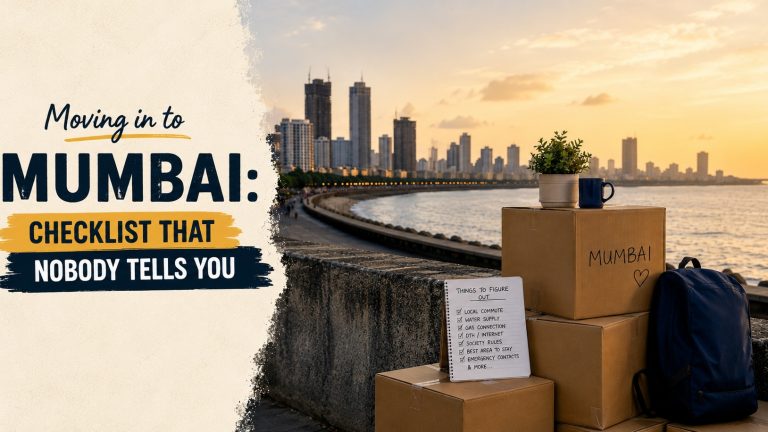
Moving to Mumbai? Got a checklist? Packed your bags? Made the bookings?
Good. Now throw that checklist away.
Here’s what nobody actually tells you before you move.
They tell you it’s chaotic. They tell you the locals are resilient. They tell you the food is incredible and the energy is unlike anywhere else. What they don’t tell you is that a 60-year-old building society secretary — who has never paid rent in his life, lives in the same flat his father got on pagdi in 1974, and considers himself the unofficial mayor of the building — will interview you before deciding whether you’re allowed to move in. He will ask where you’re from, what you do, whether you cook non-veg, and whether you have “friends visiting.” He is not the landlord. He has no legal authority. And yet.
This is not a list of tourist tips. This is what the first thirty days actually involve — the parts nobody mentions, the parts that make grown adults sit on the floor of an empty flat and question their life choices.
The Flat You Found Is Not the Flat You’re Getting
You’ll find a place. You’ll negotiate rent. You’ll shake hands with the landlord. And then you’ll meet the society.
Every residential building in Mumbai has a housing society — a registered body of residents that technically manages common areas and maintenance. In practice, a significant number of them function as informal gatekeeping committees. Some societies have rules about unmarried couples. Some about tenants from specific states. Some will ask for a “maintenance deposit” that isn’t in your rent agreement and isn’t going anywhere you can track. Some will tell you they need to “approve” you before you get the NOC required to move in.
None of this is legal in the strict sense. All of it is real.
What actually helps: Have your documents absolutely airtight — Aadhaar, PAN, company ID, offer letter if you have it, and a rent agreement that’s been notarised. The more official you look on paper, the shorter the interview.
You Will Get the Job. You Will Not Get the Maid.
This is the one nobody prepares you for.
Mumbai has a full-time domestic worker shortage in most middle-income neighbourhoods. The good bais — the ones who show up, who are reliable, who don’t disappear for six weeks during every village festival — are already employed, have been for years, and are not looking. The ones who are available are available for a reason.
Finding a bai in your first month is genuinely harder than finding the flat. It happens through building networks, through your society’s WhatsApp group, through someone’s departing tenant leaving a recommendation. It does not happen through ads or apps in any reliable way.
In the meantime: Figure out the nearest laundromat (every neighbourhood has one, nobody advertises them), accept that you’re doing dishes yourself, and ask your building watchman on Day 1 if he knows anyone. He usually does. He will want a finder’s fee. Pay it.
The Gas Cylinder Is a Weeks-Long Bureaucratic Project
If your flat doesn’t have piped gas — and most don’t outside premium buildings — you need an LPG connection. This means visiting the nearest HP Gas, Bharat Gas, or Indane distributor, filling a physical form, submitting Aadhaar and your rent agreement, and then waiting. The waiting part is two to four weeks minimum. Sometimes longer if the distributor’s quota is full, which it frequently is in dense suburban areas.
In the meantime, you are not cooking. Buy an induction cooktop for Rs.1,200 from the nearest electronics shop and keep it. Even after the cylinder arrives, the induction top is useful enough that you’ll keep it anyway.
The gas cylinder situation is also where you’ll have your first real encounter with Mumbai’s love of the physical photocopy. Bring four copies of everything. They will use two and lose one and ask for another one six weeks later.
Water Comes When It Comes
Most Mumbai buildings don’t have 24-hour water supply. Water arrives in the morning — usually between 6am and 9am — and possibly again in the evening for an hour. The exact timing varies by building, by area, and by how well the society manages the overhead tanks.
If you sleep through the morning window in your first week, you will have your first Mumbai moment: standing in front of a dry tap at 8pm, phone in hand, Googling whether this is normal. It is normal.
Ask the watchman on your first day what the water timings are. This one question will save you more grief than almost anything else on this list.
The Building Society WhatsApp Group Is a Document of Mumbai Human Nature
You will be added to it within 48 hours of moving in. It will have 47 members and a name like “B Wing Residents ?” or “Shanti Niwas Family ?.”
In the first week, someone will forward a PIB-fact-checked-false WhatsApp forward about something. Four people will say thank you. One person will post a voice note about the parking situation. The secretary uncle will post a reminder about maintenance dues in bold. Someone’s child will accidentally send a meme.
Join it anyway. It is the fastest way to find out about the maid who’s looking for extra work, the neighbour who’s selling a washing machine, the water outage at 2pm on Tuesday, and the unofficial rules of the building that nobody wrote down but everyone knows.
Auto-Rickshaws Are Not Universal and Cab Surge Will Break Your Spirit
Below Mahim in the west and Sion in the centre, auto-rickshaws are not allowed to operate. If you live in South Mumbai or Bandra and try to hail an auto, the driver isn’t being difficult — he’s legally not permitted to take you.
This matters most when it rains. And Mumbai rains.
During a heavy monsoon downpour, the roads flood in predictable spots — Hindmata in Dadar, the Andheri subway, parts of Kurla — trains slow to a crawl, and cab surge pricing enters territory that feels personal. You will sit in an Uber watching the fare tick upward while the car doesn’t move and wonder if Rs.800 for a 3km ride is your life now.
The answer is: sometimes, yes. Learn the train route to your office before you need it. On the worst rain days, the local train — even delayed — will beat every car on the road.
The Local Train Is Faster Than You Think and More Physical Than You’re Ready For
Mumbai’s suburban trains run every 3 minutes at peak hour. They are faster than almost any other way to get across the city. They are also, during those peak hours, an experience in human density that has no real comparison.
The trick that nobody tells you: don’t try to get on at the peak of rush hour in your first week. Take the train at 10am first. Understand the system — which end of the platform corresponds to which compartment, how the doors work, how people move — before you do it in a crowd of 500 people who have been doing this for twenty years and will not slow down for you.
Download m-indicator before you take your first train. It will tell you which trains stop at your station, how long until the next one, and which compartment to board. It is the most useful app in Mumbai and nobody outside Mumbai has heard of it.
The Tiffin You Need Exists. You Just Have to Find It.
If you don’t cook, a local tiffin service will change your life more than any restaurant app. For Rs.2,500 to Rs.5,000 a month, someone — usually a woman in the building or the next lane — cooks two meals a day and delivers them in steel dabbas. This is not meal-kit cooking. This is real food, made for the neighbourhood, rotating daily, with more dal and rotis than you thought one person could eat.
These services are never advertised. They run entirely on word of mouth. Ask your watchman. Ask the secretary uncle, if you’ve made peace with him by this point. Ask the person who moved in six months before you. Someone in the building knows.
Nobody Is Going to Tell You About the Noise Until You’ve Already Signed
Mumbai buildings are dense and the walls have opinions. You will hear your neighbour’s 6am alarm. You will know when the family upstairs has a disagreement. You will be woken up by a festival you didn’t know was happening, a temple speaker three lanes away, a wedding procession at midnight that is somehow legal.
This is not a solvable problem. It is a context to assess before you commit to a flat — ask to visit at night, not just on a Sunday afternoon when everything is quiet. The building you’re considering may be next to a school, a temple, a market that starts at 5am, or a garage that starts at 7. You want to know this before Month 1 becomes Month 12.
Give Yourself Three Months. Genuinely.
Almost everyone who loves Mumbai now had a bad first month. The society uncle interview, the dry tap, the surging cab, the missing maid, the noise — it lands all at once and the city feels like it’s designed to exhaust you before it decides whether you’re worth letting in.
Three months from now, the train will feel like yours. The kirana owner will know what you buy without asking. The society uncle will nod at you in the lift. The city will stop feeling like a test and start feeling like a place.
The checklist gets you through Month 1. The city does the rest.
Looking for a co-living space or rental home in Mumbai that handles the society drama and setup headaches for you? GetSetHome offers managed homes across Mumbai and other cities — move in without the hassle.