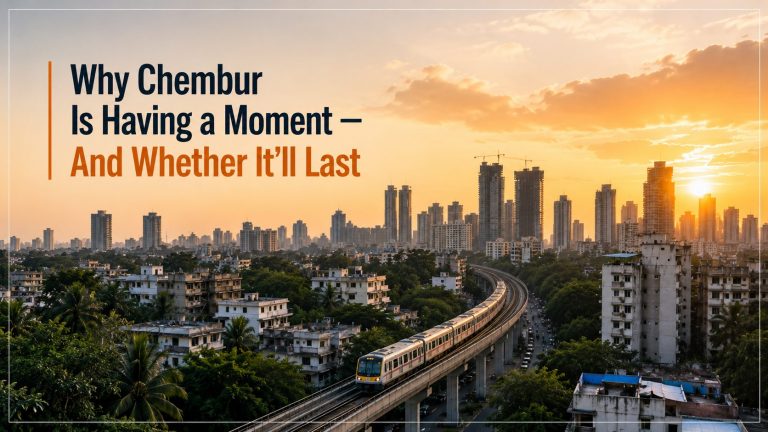
Chembur has a reputation problem, which is ironic because the reputation is about ten years out of date.
Ask someone who moved to Mumbai before 2015 about Chembur and they’ll tell you it’s an old neighbourhood, a bit industrial, more for families than young professionals, not quite the vibe. Ask someone who moved to Mumbai last year and they’ll tell you it’s one of the better decisions they made — close to everything, quieter than the western suburbs, and still priced like it hasn’t figured out what it’s worth yet.
Both of them are describing the same place. The city just moved on, and Chembur’s reputation didn’t.
What Chembur Actually Is
Chembur sits in the central-eastern pocket of Mumbai, roughly between Sion and Govandi, bordered by the Eastern Express Highway on one side and the harbour line railway on the other. It is not glamorous in the way Bandra is glamorous, and it doesn’t have Powai’s corporate campus ecosystem. What it has is something that’s quietly becoming more valuable than either: genuine connectivity in multiple directions, without the price tag that usually comes with it.
The Eastern Freeway connects Chembur directly to South Mumbai — Fort, Nariman Point, Ballard Estate — in under 25 minutes when traffic behaves. That’s a commute that professionals working in South Mumbai pay Parel or Dadar prices to achieve, and Chembur gets you there for less. The BKC angle is newer — Metro Line 2B, in phased opening through 2025-26, connects Chembur to Diamond Garden and then toward BKC and Andheri. When it’s fully operational, Chembur becomes one of the few suburbs with fast access to both South Mumbai and BKC without choosing between them.
The local train adds Dadar, CST, and the harbour line corridor. The monorail, underused as it is, connects to Wadala. Very few parts of Mumbai have this many directions to go from one spot.
The Rent Numbers, Honestly
A 1BHK in Chembur currently runs Rs.22,000 to Rs.38,000 depending on building age, floor, and exactly which pocket you’re in. Diamond Garden area — the most in-demand part — is at the higher end. Chembur Naka, Tilak Nagar, and the Deonar-adjacent areas are more accessible.
A 2BHK runs Rs.35,000 to Rs.60,000, with furnished flats in newer towers touching higher. The average rental across the area is around Rs.77,000 for a 2BHK in premium buildings, but the working professional range sits comfortably below that.
Compare this to what you’d pay for equivalent square footage in Bandra (Rs.60,000+ for a 1BHK), Powai (Rs.40,000-55,000 for a 1BHK near Hiranandani), or Dadar (Rs.35,000-50,000 for a 1BHK) — and Chembur starts looking like a gap in the market that hasn’t fully closed yet.
Property prices have appreciated 23% over five years and nearly 10% over three years. That’s not speculation — it’s infrastructure catching up to location.
Who Is Actually Moving Here
The profile of Chembur’s new tenant base tells you more than any price chart.
It’s South Mumbai office workers who can’t justify Mahalaxmi or Worli rents. It’s professionals working in BKC who want a quieter, slightly more affordable eastern alternative to Bandra. It’s people who grew up in the eastern suburbs — Ghatkopar, Mulund, Thane — and want to stay on that side of the city while upgrading their neighbourhood. And increasingly, it’s families relocating from western suburbs who’ve decided the commute savings on rent outweigh the inconvenience of not being in Andheri.
The café culture that signals early gentrification is showing up too. Chembur has a growing number of specialty coffee places, restaurants that are worth going to specifically rather than just being the nearby option, and the kind of quiet gym-and-grocery infrastructure that follows young professionals.
The Honest Downsides
Chembur is not a night-out neighbourhood. If you want to step out at 11pm on a weeknight and have options, you want Bandra or Lower Parel. Chembur quiets down earlier than the western suburbs and the entertainment infrastructure reflects that.
The building stock is mixed. Some of the older co-operative housing societies — the ones built in the 1970s and 80s — are being redeveloped, which is good for the neighbourhood long-term and disruptive in the short term. If you’re looking at a flat in an older building, check the redevelopment status. Moving into a society that gets a redevelopment notice six months later is a real scenario, and it’s one that displaces tenants with short notice.
The eastern freeway, which is the killer commute advantage for South Mumbai workers, is one-way operational during peak hours — which helps in the morning but means the return commute routes differently. This is manageable but worth knowing before you start planning your daily routine.
Will It Last?
This is the real question, and the honest answer is: the structural tailwinds are real, but Chembur is approaching the end of its undervalued window.
Metro Line 2B changes everything for this neighbourhood in the way the Metro Line 1 changed Ghatkopar a decade ago. Ghatkopar went from “affordable eastern suburb” to “surprisingly expensive” within a few years of metro connectivity materialising. Chembur is earlier in that curve, but the curve is the same.
The redevelopment wave — older pagdi and co-op buildings being replaced by modern towers — is pushing average building quality up, which brings in a different tenant profile, which pushes rents up further. This is not a bad thing for the neighbourhood; it’s a predictable pattern in every Mumbai micromarket that gets infrastructure investment.
The professionals who moved to Chembur in 2022 and 2023 got a genuinely good deal. The professionals moving there now are still getting a reasonable deal relative to comparable connectivity elsewhere. The professionals who move there in 2028, after the metro is fully embedded in the daily commute and the redeveloped towers are occupied, will be paying what Chembur has always been worth but is only now discovering how to charge.
The moment is real. The window is narrowing.
The Bottom Line for Working Professionals
Chembur makes the most sense if you work in South Mumbai or BKC, want more space than Dadar or Matunga can offer at a reasonable price, and don’t need a Bandra-style social scene walkable from your door. It’s a neighbourhood for people who’ve been in Mumbai long enough to care more about commute time and flat size than about the Instagram value of their address.
If that describes you — or if you’re moving to Mumbai and smart enough to not get anchored to the western suburbs by default — Chembur is worth a serious look right now, before it gets expensive enough that everyone agrees it was obvious in hindsight.
Looking for a managed home or co-living space in Chembur or nearby areas? GetSetHome offers managed homes across Mumbai and other cities — move in without the hassle.